Learn to reason with confidence.
Focused individual instruction in mathematics, statistics, academic writing, language arts, and English. Clear explanations. Deliberate practice. Real understanding.
Small online classes in algebra, writing, English as a second language, and the history of ideas. One teacher, small groups, and plain explanations.
New group programs launch January 10, 2027. Every course runs live online. Classes need two or three learners, depending on the course. Meeting times and weekend workshop dates are confirmed with your group before you book.
One weekend, six hours, and every step explained. For anyone who was told they are "not a math person" and wants a second try.
Fast, confident arithmetic, from multiplication up to negative numbers. Work it out in your head first, then check it on paper. A short first step before Algebra Demystified and the Math for Science series.
Try one: 25 × 12 in your head. Answer: 300, because 25 × 4 = 100 and 12 is three 4s.
Try another: 35 × 16. Double 35 to get 70, halve 16 to get 8, then 70 × 8 = 560. Doubling one number and halving the other keeps the product the same.
Build confidence with signed numbers, decimals, fractions, ratios, percents, measurement, metric conversions, and rates.
Use powers and roots, work with scientific notation, simplify expressions, solve equations, and rearrange scientific formulas.
Plot coordinates, interpret slope and functions, explore linear and nonlinear models, and use units and data to explain a scientific relationship.
Work with right triangles, sine and cosine, radians, the unit circle, waves, the Laws of Sines and Cosines, and a practical science capstone.
From confident arithmetic to scientific models and trigonometry. Get all four Math for Science courses together.
A crash course in Western thought: how people in one tradition argued about knowledge, truth, and science across 2,400 years.
Live online English for Beginning, Intermediate, and Advanced learners. Practice speaking in a small group, and build grammar one-on-one.
Algebra is arithmetic with a placeholder. Once you see that, the rules stop looking arbitrary. This weekend covers the core of Algebra I, one idea at a time, with practice after each one.
Adults returning to school, learners preparing for a placement test or the GED, teens who need a reset, and parents who want to help with homework.
Comfort with basic arithmetic, a pencil, and a notebook. A calculator is optional. We review negatives and fractions in the first hour.
A one-page reference sheet and a practice set with fully worked answers, so you can check every step on your own.
How a graph moves, flips, and stretches when you change its equation. The dashed starting graph is y = x2, except the y-axis reflection example, which starts from y = (x − 2)2.
y = f(x) · f(x) = x2
y = a f(b(x − h)) + k
Tap any card or box to see it larger.
Why the y-axis example uses (x − 2)2: the plain parabola y = x2 is symmetric about the y-axis, so f(−x) leaves it unchanged. A shifted parabola shows the flip.
| Where the change is | Rule | What to remember |
|---|---|---|
| Outside f(x) | f(x) + 4 | Up 4 |
| Outside f(x) | f(x) − 4 | Down 4 |
| Inside f(x) | f(x − 4) | Right 4 |
| Inside f(x) | f(x + 4) | Left 4 |
| Negative outside | −f(x) | Flip over the x-axis |
| Negative inside | f(−x) | Flip over the y-axis |
| Number outside | 3f(x) | Vertical stretch by 3 |
| Fraction outside | (1/3)f(x) | Vertical compression by a factor of 1/3 |
| Number inside | f(3x) | Horizontal compression by a factor of 1/3 |
| Fraction inside | f((1/3)x) | Horizontal stretch by a factor of 3 |
Outside = vertical, as written. Inside = horizontal, opposite. Negative outside = x-axis flip. Negative inside = y-axis flip. Inside stretches use the reciprocal.
Aprende, explora, ¡resuelve!
Read every guide free online, and zoom in as far as you need. Printing is turned off; a printable copy is $1. Put the guide's title in your payment note, and the PDF is sent to your email.
Browse by subject: Math · Algebra · Math for Science · Language Arts & Logic · ACT Prep
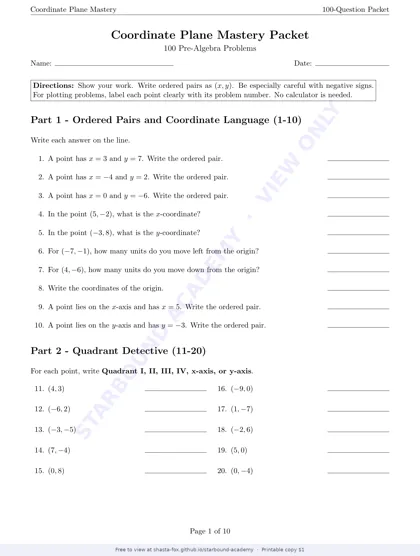
Ordered pairs, quadrants, plotting, reading the plane, reflections, translations, distance, missing points, and a five-problem challenge.
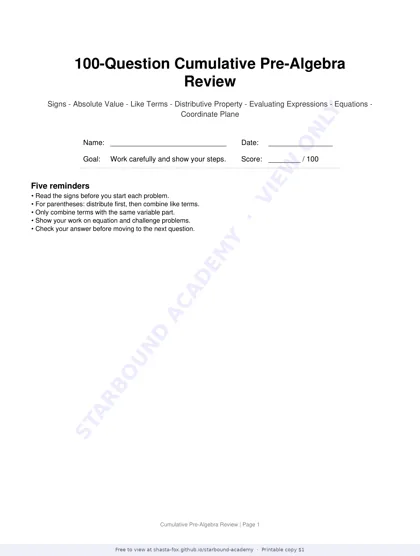
Signs and integer operations, absolute value, like terms, the distributive property, evaluating expressions, equations, and the coordinate plane.
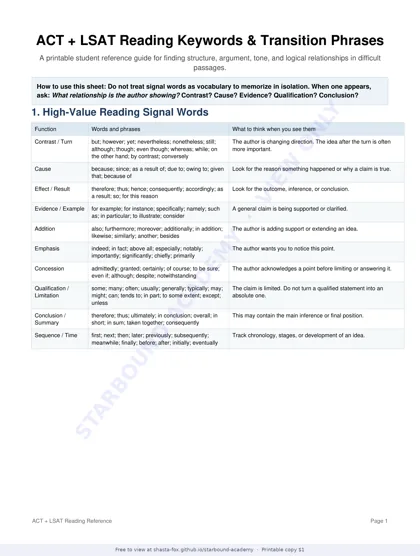
Signal words grouped by what they do, tone words, transition phrases, eight questions to ask of any passage, and a short practice set with answers.
Six evenings, six turning points. Each session pairs a short primary reading with a discussion of one question: how do we know what we claim to know?
Socrates claimed to know only that he knew nothing. Plato built on his method and argued that true knowledge concerns unchanging forms, not shifting appearances.
Reading: Plato, Apology and the allegory of the cave (Republic, Book VII)Aristotle grounded knowledge in observation and formal logic. His work reached medieval Europe largely through Arabic translations and commentators such as Ibn Rushd, and Thomas Aquinas joined it to Christian theology.
Reading: Aristotle, Nicomachean Ethics, Book I (excerpt); Aquinas, the five ways (excerpt)The scientific revolution replaced appeals to authority with experiment and mathematics. Descartes tried to rebuild all knowledge from a single certainty.
Reading: Descartes, Discourse on Method, Part IIHume showed that no number of observations proves a general law. Kant answered that the mind itself supplies the structure of experience.
Reading: Hume, An Enquiry Concerning Human Understanding, Section IV; Kant, "What Is Enlightenment?" (1784)Four thinkers turned the question toward society and history: free debate, economic power, natural selection, and the origin of values.
Reading: Mill, On Liberty, Chapter 2; Marx and Engels, The Communist Manifesto, Part IPopper argued that a scientific claim must be testable and open to refutation. Kuhn argued that science moves through paradigms and occasional revolutions, not a steady pile-up of facts.
Reading: Popper, "Science: Conjectures and Refutations" (excerpt); Kuhn, The Structure of Scientific Revolutions (1962), excerptThis course follows one tradition. It is not the only tradition of rigorous thought, and it did not develop alone. Where Western thinkers drew on Islamic, Indian, Chinese, African, or Indigenous scholarship, the course says so.
One-on-one · Live online · English or Spanish
Mathematics, statistics, quantitative reasoning, and graduate writing. Bring the problem, paper, or concept you want to work through.
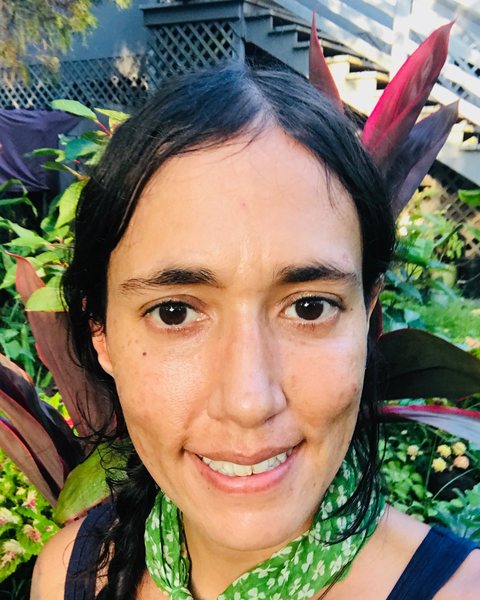
Learn with Shasta Fox, a doctoral student with an M.A. in Interdisciplinary Studies (writing and English) from Western New Mexico University and a B.A. in History from the University of Arizona.
From arithmetic foundations to algebra, coordinate geometry, functions, matrices, and dimensional analysis. Work through each step and understand why it works.
Support with quantitative research methods, interpreting data, error analysis, and explaining your reasoning. Send your topic or assignment first so we can confirm a good fit.
Writing coaching and editing for essays, technical writing, thesis methodology chapters, and clear descriptions of research design. Feedback helps you strengthen your own argument and revision.
Reading, grammar, vocabulary, comprehension, pronunciation, and English-language learning. Sessions are available in English or Spanish.
Live online for learners in Arizona, Hawaiʻi, and beyond. Send your subject, goals, deadline, and time zone to arrange a session.
For graduate editing, email the document length and type of help you need before booking. Standard essay review remains $30 per essay.
Written notes on your essay, sent back by email. $30 per essay.
Payment comes first. Essays are read only after payment arrives.
Shasta Fox teaches every Starbound class.

Enrolled tribal members: tutoring is $15 per 50-minute session. Math for Science is $80 per course or $200 for all four. Ask about full tuition support based on financial need.
Request a lesson or courseEmail Shasta Fox at shastaandziggy@gmail.com.