Worksheet200 problems · 4 pages
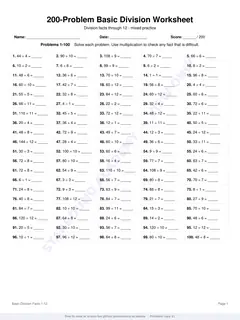
Basic Division Facts Through 12
Mixed division facts from 1 to 12 in two sets of 100, with a score line and a reminder to check hard facts with multiplication.
Browse the infographics → One-page math and science references, shown as previews.
Every guide is free to read and zoom online. Printing is turned off; a printable copy is $1. Put the guide's title in your payment note, and the PDF is sent to your email.
Showing all 34 guides
Division facts, long division, decimals, and a cumulative arithmetic review.
Mixed division facts from 1 to 12 in two sets of 100, with a score line and a reminder to check hard facts with multiplication.
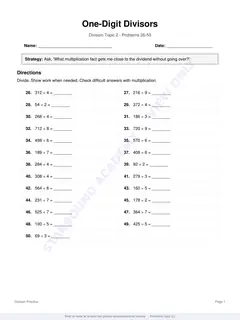
Long division with one-digit divisors. A strategy prompt asks which multiplication fact gets close to the dividend without going over.
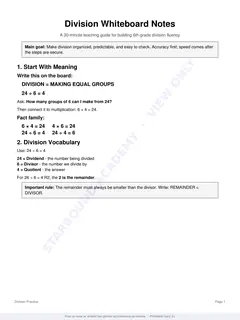
A teaching guide for 6th-grade division fluency: division as equal groups, the Divide–Multiply–Subtract–Bring Down routine, and checking answers with multiplication.
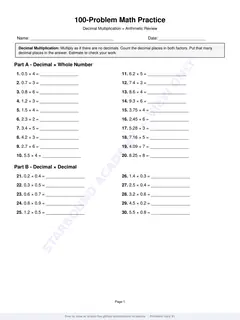
Decimal × whole number, decimal × decimal, adding and subtracting decimals, division review, negative numbers, and word problems.
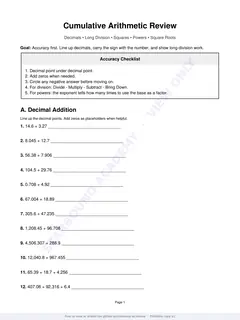
Decimal addition and subtraction, mixed decimal operations, long division with big numbers, squares, powers, and square roots.
Pre-algebra worksheets and board notes, equations, and the transformation reference and poster.
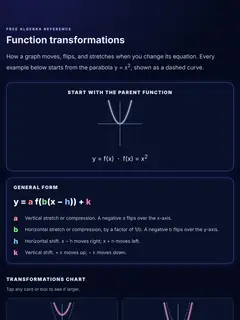
How y = a·f(b(x − h)) + k moves, flips, and stretches a graph, with ten graphed parabola examples you can open, a memory chart, and quick examples.
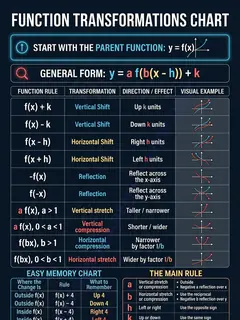
The general form y = a·f(b(x − h)) + k, with each shift, reflection, stretch, and compression sketched, an easy memory chart, the main rule for a, b, h, and k, and quick examples.
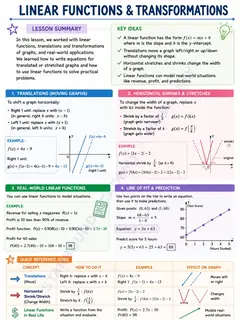
Translations, horizontal shrinks and stretches, real-world linear models, and lines of fit, with a quick reference table.
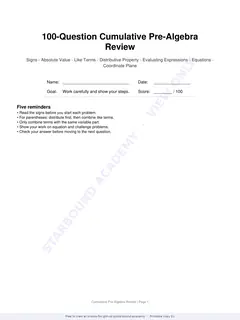
Signs and integer operations, absolute value, like terms, the distributive property, evaluating expressions, equations, and the coordinate plane.
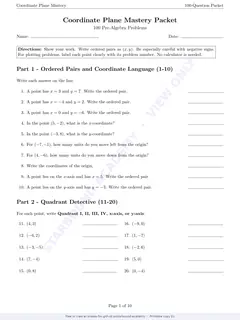
Ordered pairs, quadrants, plotting, reading the plane, reflections, translations, distance, missing points, and a five-problem challenge.
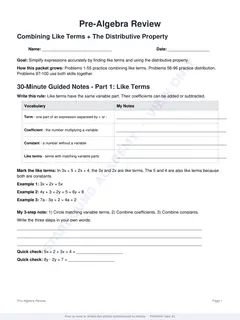
Guided notes, then 55 like-terms problems, 41 distribution problems, and 4 that use both skills.
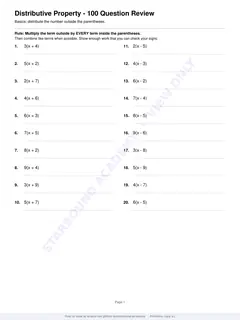
From 3(x + 4) to −2x(x − 5) − 3x: distributing positives, negatives, decimals, and variables, then combining like terms.
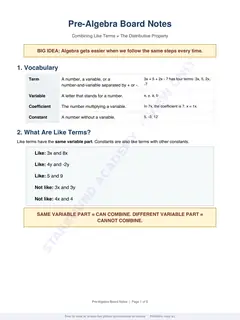
Vocabulary, combining like terms, watching the signs, distributing a negative, a full mixed example, quick checks, and a 30-minute board plan.
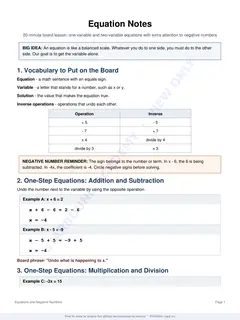
One- and two-step equations, double negatives, checking answers, two-variable equations, solving for y, and an equation checklist.
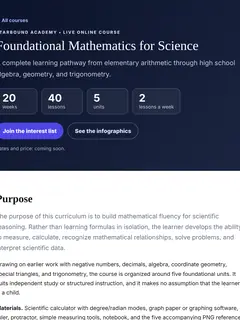
The Foundational Mathematics for Science curriculum, its five unit infographics, and reference posters for vectors, statistics, probability, scientific reasoning, and science equations.
The full course: five units, a week-by-week plan, learning outcomes, the lesson cycle, assessments, and a triangle-solving reference.
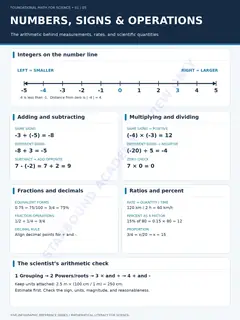
The number line, signed arithmetic, fractions and decimals, ratios and percent, and a scientist’s arithmetic check.
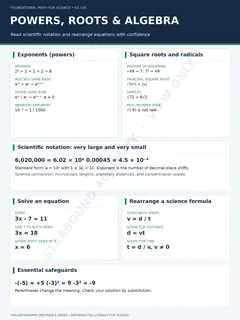
Exponent rules, square roots and radicals, scientific notation, solving an equation, and rearranging a science formula.
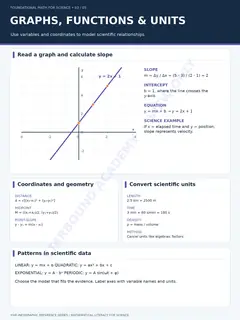
Slope and intercept from a graph, distance and midpoint, unit conversions and density, and four patterns in scientific data.
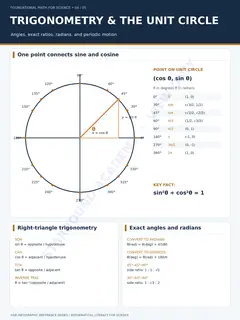
The unit circle with exact values, SOH CAH TOA, inverse trig, converting degrees and radians, and special right triangles.
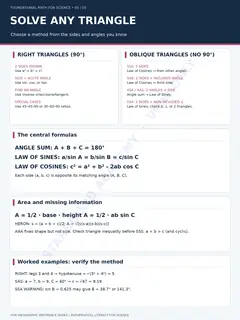
Choosing a method for right and oblique triangles, the Laws of Sines and Cosines, triangle area, and worked examples, including the SSA case.
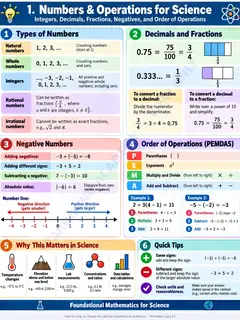
Types of numbers, decimals and fractions, negative numbers, the order of operations with two worked examples, and where each skill shows up in science.
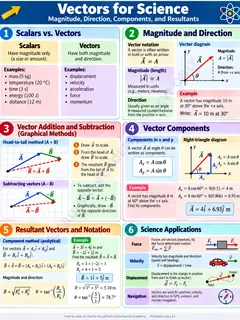
Scalars and vectors, magnitude and direction, adding and subtracting vectors head to tail, components, resultants, and uses in force, velocity, and navigation.
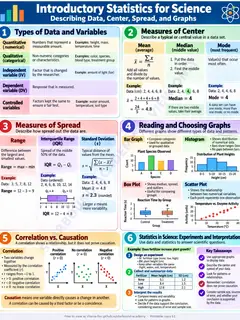
Types of data and variables; mean, median, and mode; range, IQR, and standard deviation; choosing a graph; and correlation versus causation.
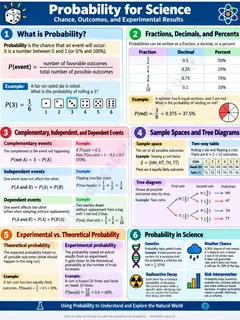
Probability as a fraction, decimal, and percent; complementary, independent, and dependent events; sample spaces and tree diagrams; and experimental versus theoretical probability.
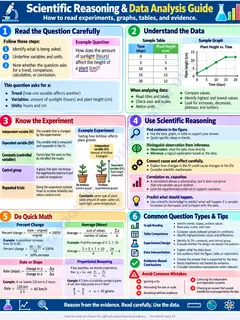
Reading a question, a data table, and a graph; experiment vocabulary; observation versus inference; quick math for percent change, averages, rates, and proportions; and common mistakes.
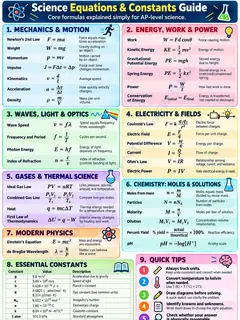
Core formulas for mechanics, energy, waves, electricity, gases and heat, chemistry, and modern physics, with a table of essential constants and quick tips.
ACT English and reading strategy, the reading keywords and transitions guide, and a beginner logic booklet.
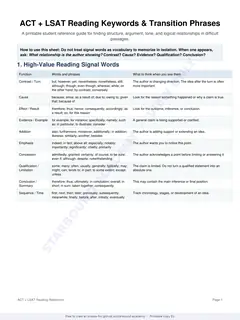
Signal words grouped by what they do, tone words, transition phrases, eight questions to ask of any passage, and a short practice set with answers.
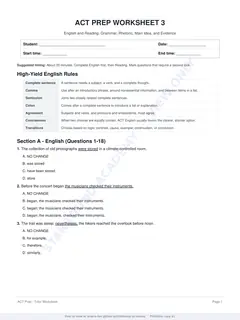
High-yield grammar and punctuation rules, rhetoric, main idea, and evidence questions, with two short reading passages.
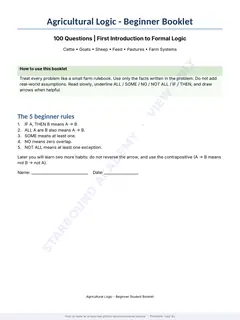
A first introduction to formal logic through farm rules: IF–THEN, ALL, SOME, NO, and NOT ALL, not reversing the arrow, the contrapositive, and two-rule chains. Ten units, each with a worked example.
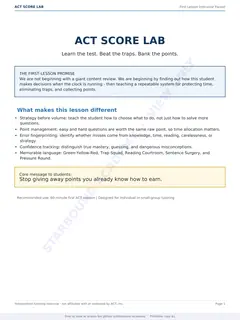
A diagnostic, math and English worksheets, and first-lesson playbooks for each section.
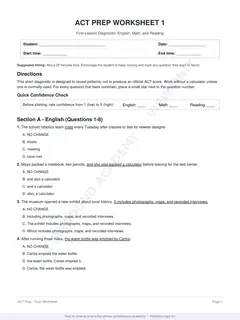
A short English, math, and reading diagnostic that reveals patterns rather than producing an official score.
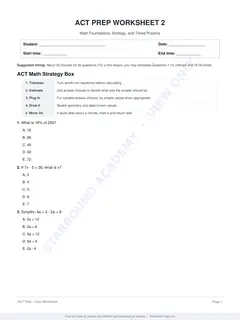
A math strategy box (translate, estimate, plug in) and 30 questions, with the option to work half untimed and half timed.
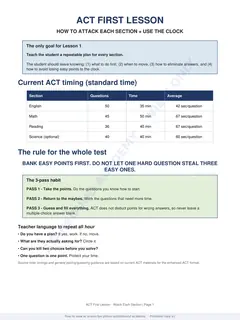
Section timing, a move rule for English, math, and reading, and a cut-out student quick card.
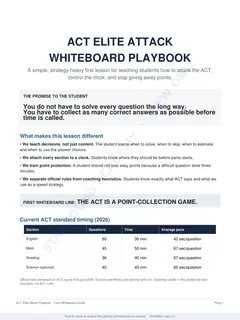
A strategy-heavy first lesson on attacking each question, controlling the clock, and spotting English traps.
The SCORE system (scan, cut, own the clock, reason first, execute and exit), with signature activities, an error fingerprint, and a student strategy card.
No guides match that search.